
The Wheelbarrow Orchestra
Mud, Music and Making Things Better: A Winter Appeal from Orchard Barn

Some people count sheep to fall asleep. I, on the other hand, count wheelbarrows.
Not because I’m eccentric (though that may be part of it), but because at Orchard Barn the wheelbarrows have become something like a choir. A somewhat dented, muddy, temperamentally unreliable choir — but a choir nevertheless. They sing, hum, growl, and occasionally sulk. I hear them when I’m drifting off, when I’m waking up, and sometimes even in dreams.
The wheelbarrows have spoken, and they have a lot to say.
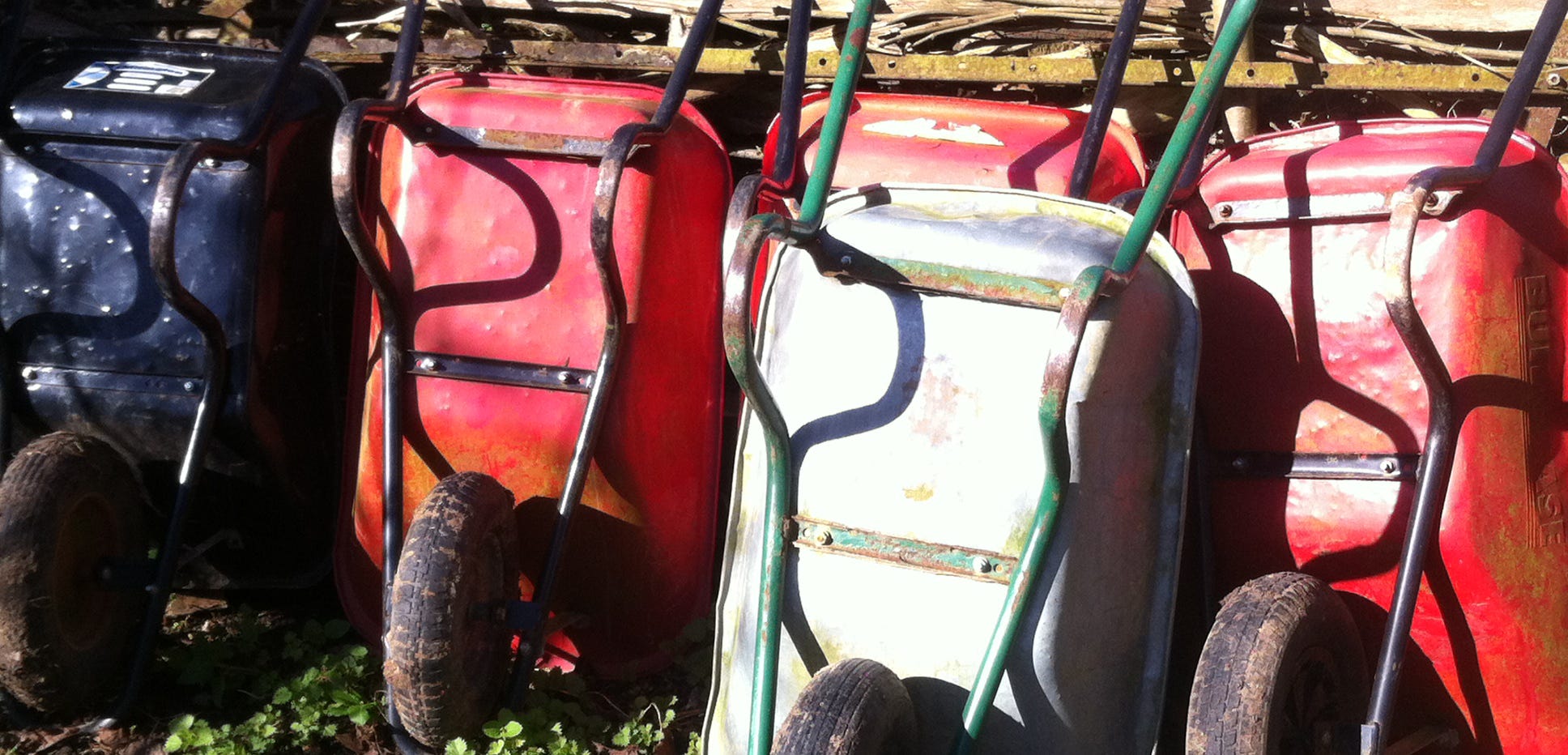
The Growler
There’s one that sounds like a wounded wild animal, warning you not to approach unless you’re prepared for teeth.
Its wheel rubs against the underside of the carrying bit — the name of which I should absolutely know, given the respect I claim to have for these creatures. (Is “top” good enough? Let’s pretend it is.)
This barrow limps, hums, and protests, but it still manages to carry more than seems fair.
A lesson for all of us, perhaps.
The Pensioners by the Bridge
Two elder barrows spent the summer stationed by the Billy-Goat-Gruff-style bridge, filled to the brim with clay from the car park mountain we moved back in May. Their job? Be temporary storage. Though “temporary” at Orchard Barn often means “until the next geological era.”
They grew nettles.
They grew grass.
They grew on me.
Their perished tyres lodged them firmly into the soil. They weren’t going anywhere — until the day Emmie and Philip emptied them recently, freeing them just before true winter set in. Rust was threatening. Pride was at stake. Redemption felt possible.
The Little Metal One
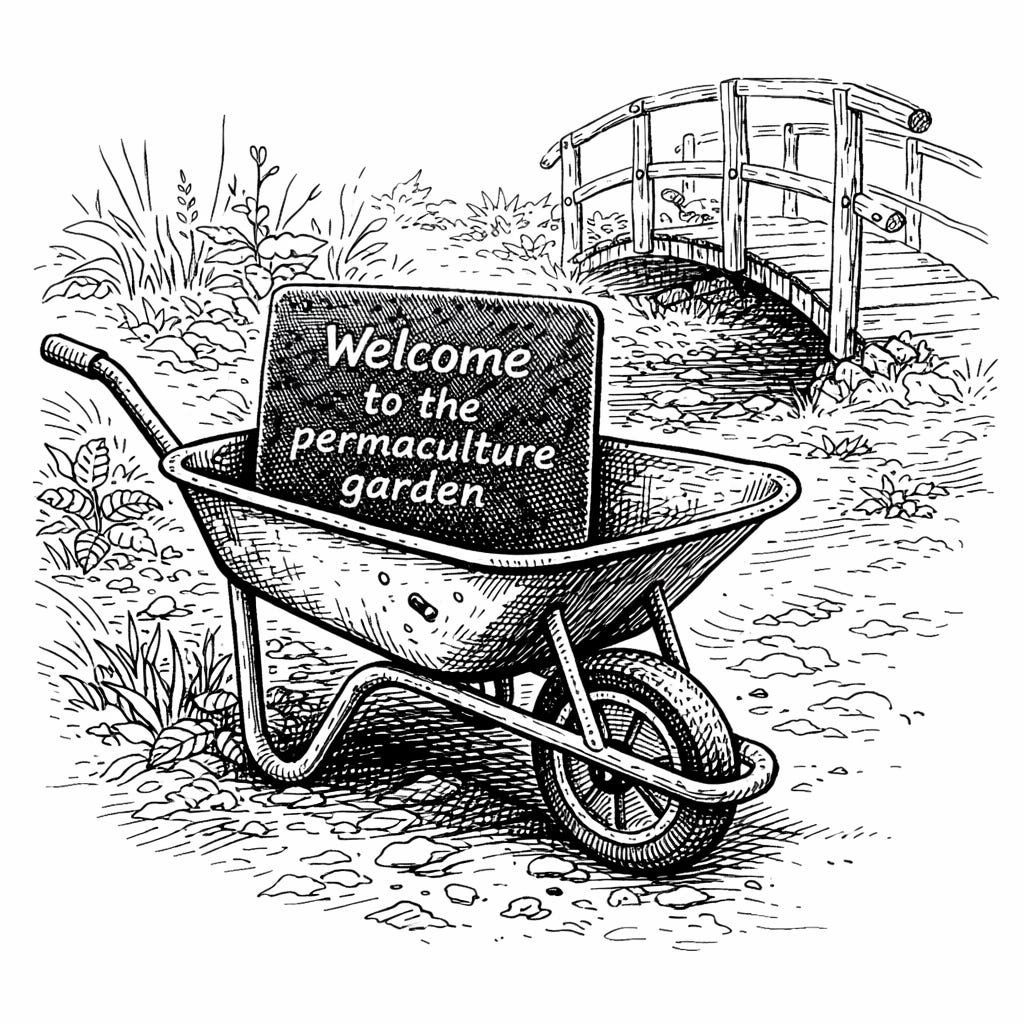
A third companion sits at the garden entrance — a small metal Freecycle barrow I adopted from Rattlesden. Its wheel hardly spins, its body is tiny, but with an old slate reading “Welcome” resting in it, it has become our quiet greeter.
Technically retired. Spiritually employed.
A Growing Flock
Our fleet now numbers twelve (thirteen if you count the miniature diplomat at the gate). Nine are working well. Not bad for an orchard choir.
In the old days, finding one wheelbarrow with a functioning tyre felt like a minor miracle. Now the challenge is keeping track of them. They wander. They disappear. They gather in corners like gossiping hens or sheep that have slipped the fence.
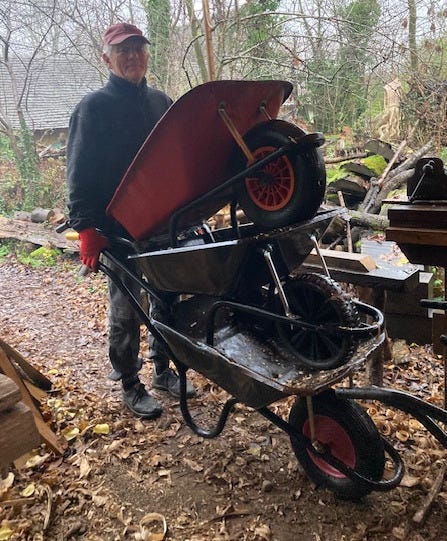
Every evening I gather them, upended against the earth wall, protected from the wind. Their silhouettes at dusk make me smile. I sleep better knowing they are accounted for.
The Barrow That Sings
And then there’s her.
The barrow that hums.
When her wheel brushes against the body, she produces a sound somewhere between a chant and an OM. I feel it in my hands as I push her. The more she carries, the more she hums.
Some tools have a life-force, and this one reminds me daily why slow work matters.
Old Skills, New Futures
It’s funny — wheelbarrows aren’t glamorous. But without them, none of our winter work would be possible:
the pond restoration, the hedge-laying, the reshaping of margins and ledges for amphibians who will return in spring whether we’re ready or not.
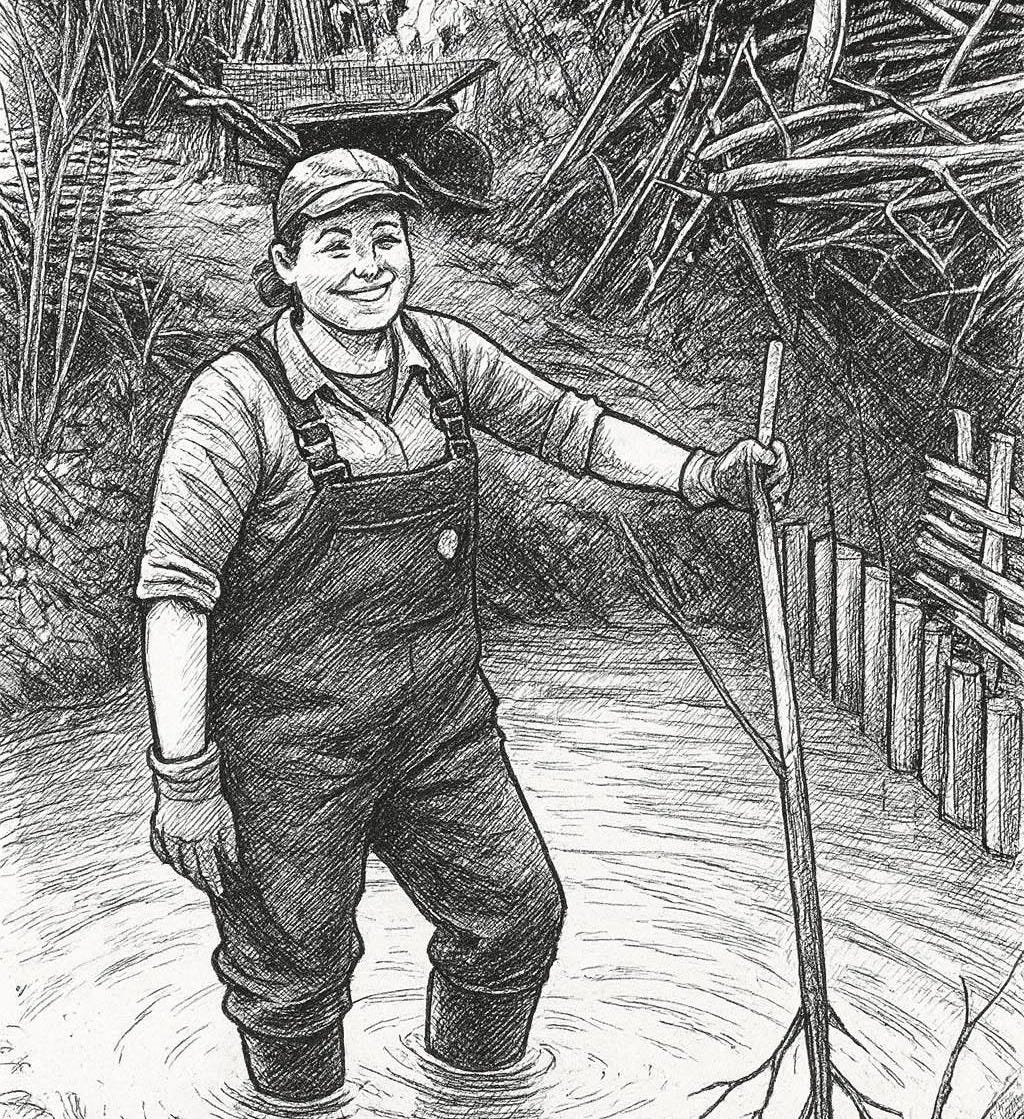
The clay that filled the pensioner barrows has now become part of the pond’s new wildlife-friendly edges. Soon it will also appear in our Clay Paint Making course — the same Orchard Barn clay, doing double duty as both habitat and pigment. I love that.
The elm “faggots” created from hedge-laying off-cuts — once used historically to stabilise riverbanks — are now being packed behind sweet chestnut stakes to rebuild the pond’s contours.
And in workshops like Pole Lathe Turning, the rhythm of hand tools echoes the rhythm of that humming barrow — old skills shaping new futures.
These are not hobbies.
They are acts of recovery.
Why I’m Sharing This Story
Because our wheelbarrow orchestra is part of something bigger:
our Nature Recovery Fund Raising Campaign.
The work has already begun — mild weather gave us the courage to start early — but the funding will determine how much we can achieve before the frogs and toads return to spawn in barely two months.
Your support helps us:
rebuild ponds and water habitat
continue hedge-laying for wildlife corridors
construct a BIG Bug Hotel for pollinators
teach these skills to more people
and steward this land with care, humour, and hope
And in return, we’ve created a set of unique Rewards, available only until 31st December:
🌿 Hedge-laying — winter craft & biodiversity in action
🔨 Traditional Timber Framing — working oak with hand tools
🪵 Pole Lathe Turning — green woodworking with joy
🎨 Clay Paint Making — using our own Orchard Barn clay
🏺 Cob & Earth Mortar, Heritage Hot Lime, and more
Every course place supports the restoration work — meaning your learning literally creates more habitat. (See Crowdfunding campaign for dates and donations for rewards.)
The Choir Awaits
I’m off now to gather the barrows again before dusk. The humming one will sing, the growler will complain, and the pensioners — if Bobby can fix their wheels — may even get a second spring.
If you’d like to help us continue this muddy, hopeful, necessary work, here’s the link to our campaign (scroll down for Rewards):
👉 https://www.crowdfunder.co.uk/p/orchard-barn-biodiversity-boost
Together, we can turn tools, traditions, and stories into thriving habitat.
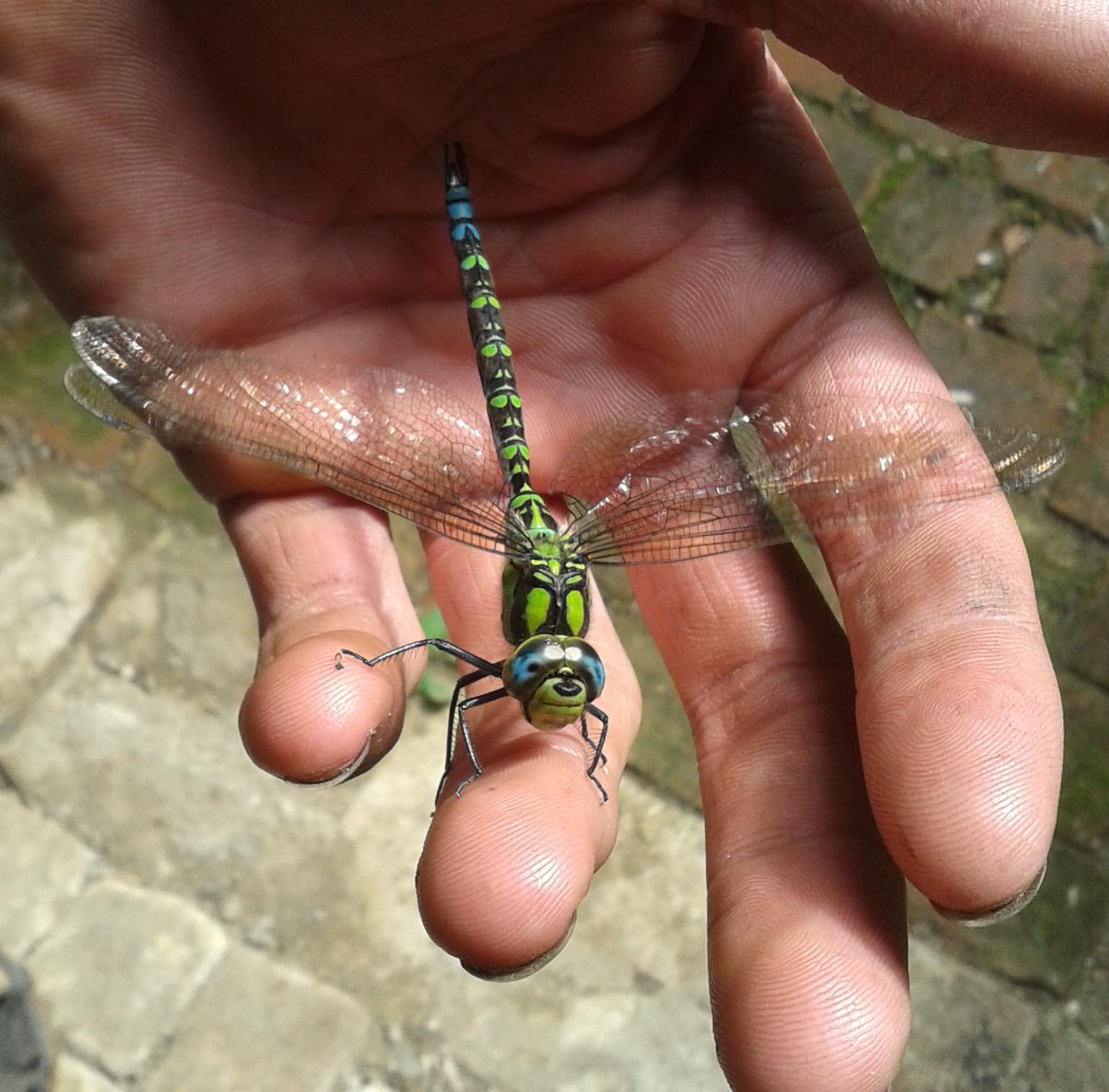
And maybe — just maybe — expand the orchestra AND bring back our friends the dragonflies.
Think I can relate to the Growler!